Baltimore Building of the Week: The Basilica

This week’s featured Baltimore Building of the Week from Dr. John Breihan is the Basilica of the National Shrine of the Assumption of the Blessed Virgin Mary, a National Historic Landmark, National Shrine, Marian Shrine, and Co-Cathedral of the Archdiocese of Baltimore. You can become a fan of this incredible building on Facebook or take a guided tour Monday through Saturday.
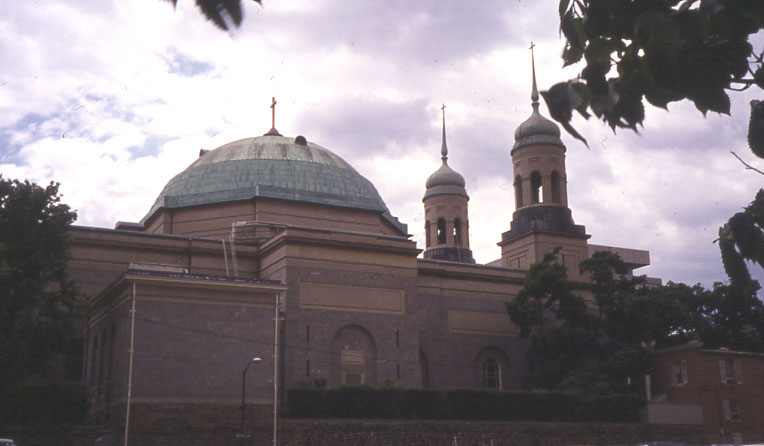
Image courtesy Jack Breihan

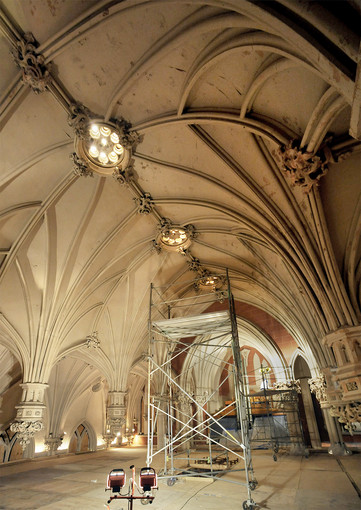
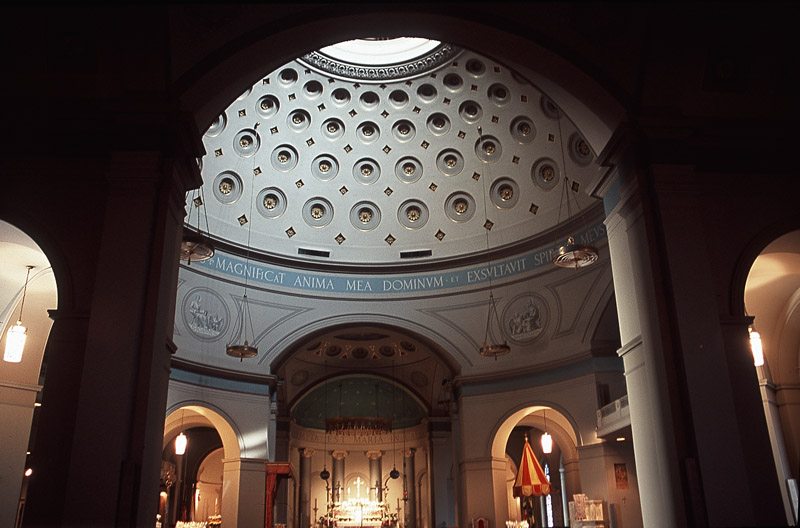
By far the greatest architectural masterpiece in Baltimore is its long-time Catholic cathedral, now known as the Basilica of the Assumption. Designed by Benjamin Henry Latrobe for Archbishop John Carroll, the Basilica was built between 1806 and 1820. The great domed church with its curious cylindrical towers, our Hagia Sophia, long dominated the Baltimore skyline. To mark its bicentennial in 2006, the Basilica underwent a much-needed rehabilitation of its basic systems and a conjectural restoration of the interior to its appearance in 1820. While some welcome the new bright pastels, others miss two centuries’ accretions of church furniture, gold leaf, and stained glass.
Continue reading

Call for 2010 Preservation Award Nominations

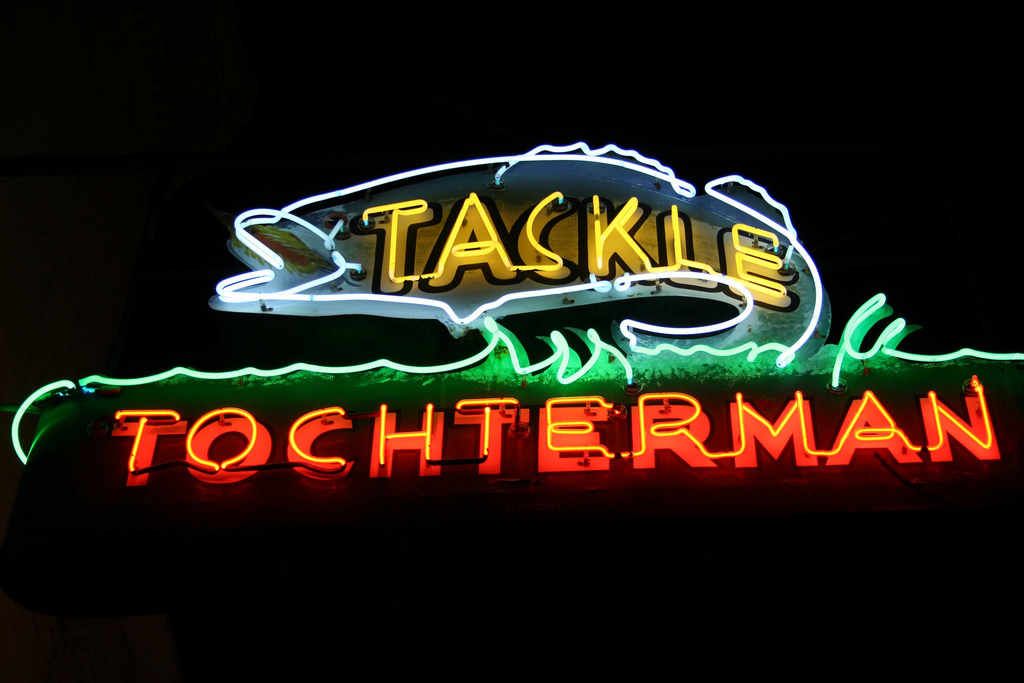
Tochterman-Fishing-Tackle-neon-sign

Image courtesy elh70 on Flickr

What do the the Clarence Mitchell Courthouse, the SS John Brown, and the neon Tochterman’s Fishing Tackle sign on Eastern Avenue have in common? They have all won historic preservation awards from Baltimore Heritage over the last 50 years, of course.

This year, Baltimore Heritage turns 50. Please help us celebrate a half-century of preserving historic places in our great city by submitting a nomination for a 2010 Preservation Award. Whether it’s your own do-it-yourself home rehabilitation project, a neighbor who has put her heart and sole into preserving a historic space, or an organization that has shown commitment to preserving the city’s heritage, we’d love to get a nomination from you.

Continue reading

Baltimore’s West Side Story Revisited

In a great new post on Baltimore Brew, Joan Jacobson and Elizabeth Suman lay out the story of the continuing threats to Baltimore’s historic West Side, an area that has been listed on the Baltimore Heritage Preservation Watch List for nearly 10 years. Among the dozens of irreplaceable buildings still threatened with demolition is the Art Deco styled 1934 Read’s Drug Store, designed by renowned Baltimore architecture firm Smith & May, the same firm that created the iconic Bank of America Building. In January 1955, following a year of negotiations with Read’s, a sit-in demonstration organized by the Baltimore Congress of Racial Equality led to the desegregation of 37 Read’s lunch counters citywide, establishing a enduring association between this downtown corner and the struggle for civil rights in Baltimore and the state of Maryland.

Baltimore’s West Side Story from Baltimore Heritage on Vimeo.

For many, the story of fighting for preservation on Baltimore’s West Side is a familiar one. In 1999, the National Trust for Historic Preservation identified the West Side as one of America’s 11 Most Endangered Historic Places. In the early 2000s, Baltimore Heritage, Preservation Maryland, and West Side Renaissance created Baltimore’s West Side Story, produced by West Side Renaissance director Ronald Kreitner. This documentary screened daily at the historic Senator Theater, introducing audiences to the vital issues at stake in the preservation of historic buildings and small businesses on Baltimore’s West Side. Enjoy the whole 9 minute video to learn more or jump to 1:04 for a special cameo by former Mayor and Governor William Donald Schaefer as a born-again preservationist.

Baltimore Building of the Week: Homewood House

This week’s featured Baltimore Building of the Week from Dr. John Breihan is Homewood House at 3400 North Charles Street on the campus of The Johns Hopkins University. The Homewood House Museum is currently hosting a four-part speaker series in association with their fourth annual student-curated focus show, On the Road: Travel and Transportation in Early Maryland. The first event in the series is David Shackelford, Chief Curator at the Baltimore & Ohio Railroad Museum, speaking tonight, February 18, 2010 at 4:30 PM.

Image courtesy of John Breihan

Even the wealthy Charles Carroll was shocked by the cost of his son’s country villa, Homewood, built early in the 19th century on a hillside north of town.  A federal-style version of the standard five-part Georgian Palladian mansion house (see Mt. Clare), Homewood’s principal floor is tall, elegant, airy, and cool.  Service rooms are tucked away in the basement or attic (there is a fine brick privy in back).  The Johns Hopkins University acquired the surrounding estate and built a new campus there early in the 20th century.  Homewood is open to the public as part of Johns Hopkins University Museums.

Behind the Scenes Tour of the First and Franklin Presbyterian Church

Image courtesy Baltimore Sun

We have a rare opportunity to climb up into the scaffolding inside one of the great interior historic spaces in Baltimore: the First and Franklin Presbyterian Church in Mount Vernon.  The church is in the midst of renovations, and we have a chance to see the historic building up close and up high before the scaffolding comes down with Rev. Dr. Alison Halsey, the church’s pastor and our tour guide.

The renovations are being undertaken by the architecture firm of Murphy and Dittenhafer.  Principal architect Michael Murphy, who was overseeing the work, passed away unexpectedly last week–an enormous loss for preservation and architecture in Baltimore.  We are holding this tour as a tribute to Mr. Murphy and his contributions to Baltimore.

Tour Information

Date:   Sunday, February 21, 2010
Time:   2:00 PM – 3:00 PM
Place:   First and Franklin Church, 210 West Madison Street at the corner of Park Avenue
Meet at the church’s “Backus House,” on Madison Avenue next to the church
Park on the Street
Cost:    $10
Continue reading

Behind the Scenes Tour of the Baltimore Bar Library

A gem within a gem, the historic Baltimore Bar Library sits on the sixth floor of the historic Clarence Mitchell Jr. Courthouse with its barrel vault ceiling and luxurious oak paneling. Please join us for a tour of this fantastic space with three luminary tour guides: retired chief judge Joseph Kaplan, federal judge and Bar Library historian James Schneider, and Bar Library director Joseph Bennett. If you can’t make it out for the tour, you might enjoy this Legal Historian’s Tour of Baltimore from the Thurgood Marshall Law Library at the University of Maryland School of Law.

Image courtesy the Baltimore Bar Library

Tour Information

Cost:    $15 (includes wine and cheese reception)
Date:     Thursday, February 18, 2010
Time:     5:30 to 6:00 p.m. — Wine and Cheese
6:00 to 7:00 p.m. — Tour
Place:    Baltimore Bar Library, within the Clarence Mitchell Courthouse (map)
Park on the Street
Cost:      $15 (includes wine and cheese reception)
Continue reading

Threatened: Royer’s Hill ME Church

Anderson Automotive Site, WV Urban Developments LLC

In November 2009, WV Urban Developments LLC presented their plans to develop the former Anderson Automotive Site with a Lowe’s, a grocery store, 32,000 square feet of retail, and up to 60 apartments in an area of  approximately 11 acres bounded by 25th Street to the north, Maryland Avenue to the east, 24th Street to the south and the CSX rail line to the west (map). The developer’s presentation to the community is available on the Charles Village Civic Association website here (PDF). After meetings with the Remington Neighborhood Alliance, the Greater Remington Improvement Association, the Charles Village Civic Association, and the Old Goucher Community Association the proposal was covered in a series of posts on Baltimore Brew, in the Baltimore Sun, and The Alligator, a Remington neighborhood blog. While the prospect of expanding neighborhood amenities, new jobs, and broader economic development is exciting, Baltimore Heritage has significant concerns regarding the proposed demolition of the former Royer’s Hill Methodist Episcopal Church at the southeast corner. This 1891 stone building began as a mission of the Lovely Lane Methodist Church and still serves as a landmark within the Remington neighborhood. We believe that this stone building, which retains significant historic character, should be preserved and utilized to help establish a successful transition between the large commercial development and the historic residential Remington neighborhood.

February 7, 2009, Image courtesy Dottie Campbell

Continue reading

Baltimore Building of the Week: 9 North Front Street

Staying in the historic Jonestown neighborhood for another week in our Baltimore Building of the Week series, Dr. John Breihan shares an exceptional example of the characteristic federal row house: 9 North Front Street. Read on then click here for an additional photo of 9 North Front Street from the interesting Monument City project.

Image courtesy Jack Breihan

Image courtesy Jack Breihan

The federal style of architecture was popular during Baltimore’s most vigorous period of growth, from the 1790s to the 1850s, when Baltimore vaulted into second place among American cities. The new residents were mostly housed in 1, 2, and 3½-story dormered brick row houses, less ornate than their Georgian predecessors. They are to be found all around the bustling harbor, from Fells Point through Little Italy and Jonestown to Federal Hill. A good example is 9 N. Front Street, the home of Baltimore’s second mayor, Thorowgood Smith, built in 1790. It was saved from deterioration by the Women’s Civic League during the 1970s. Other federal row houses preserved for public use include the Mother Seton House, the Star-Spangled Banner Flag House, and the Edgar Allen Poe House.

Baltimore Building of the Week: Carroll Mansion

This week’s featured Baltimore Building of the Week from Dr. John Breihan is the Carroll Mansion built in 1811 at 800 East Lombard Street. If you enjoy this post be sure to support Carroll Museums, follow their blog, become a fan on Facebook,  or follow @CarrollMuseums on Twitter.

Image courtesy Jack Breihan

The years just before and after 1800 saw Baltimore’s greatest expansion. With it came a new style of architecture – called “Regency” in Great Britain and “Federal” here. Although still using Flemish bond brickwork and gabled roofs with dormer windows, the Federal style was lighter than Georgian, with moldings less deeply inscribed and gables less steep.  Shallow decorative panels adorned exterior walls, and entrances were often marked by elegantly slim columns. A leading example is the town mansion of Charles Carroll of Carrollton, signer of the Declaration of Independence and one of the young republic’s richest men.  When not residing in this house along the Jones Falls, Carroll lived at his country house, Doughoregan Manor in what is now Howard County. After Carroll’s death his house was put to a number of uses, causing increasing dilapidation until it was saved by the City of Baltimore.  It is now lovingly tended by the Carroll Museums, Inc.

Behind the Scenes Tour of the Hotel Brexton – Updated

Since 1881, the Hotel Brexton has lorded over Tyson Street and Park Avenue in Mount Vernon and will do so again after a recent and thorough restoration.  Please join architect Donald Kann and members of the RWN redevelopment team on a tour of this wonderfully restored building on the eve of its reopening (literally: the hotel opens to the public the morning after our tour).

Tour Information – Updated

Update- The tour of the Hotel Brexton has been rescheduled for Wednesday, February 17.  Tour registrants should look for an e-mail with an update on whether they are set for the 5:30 PM or the 6:30 PM tour.

Date:     Wednesday, February 17, 2010
Time:     5:30 PM to 7:30 PM
Place:    Brexton Hotel, 868 Park Avenue
Park on the Street
Cost:      $10

Continue reading