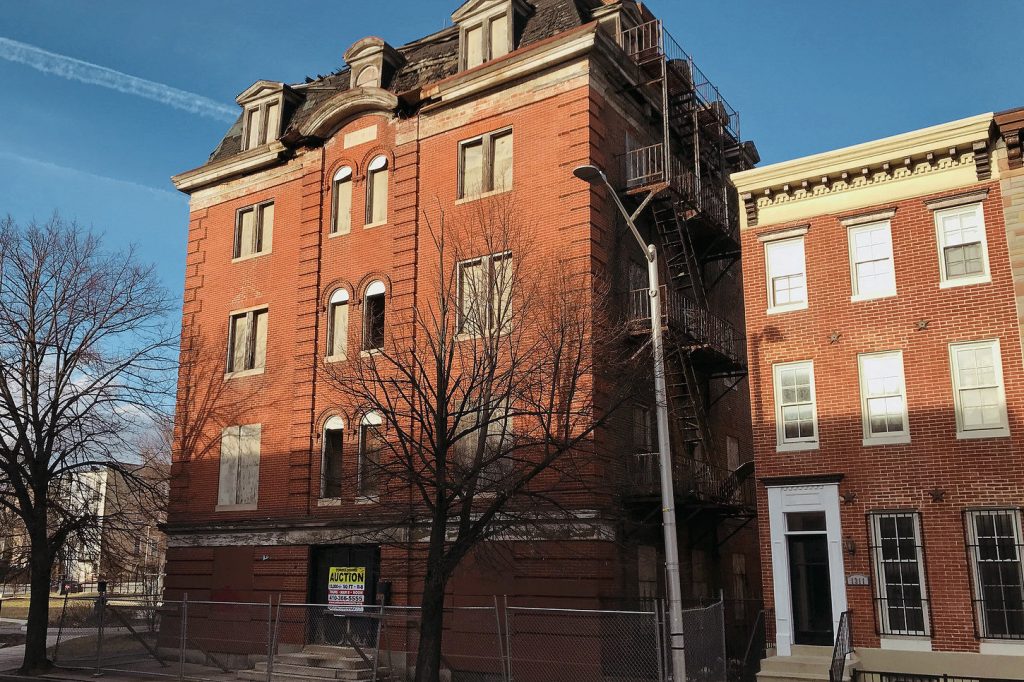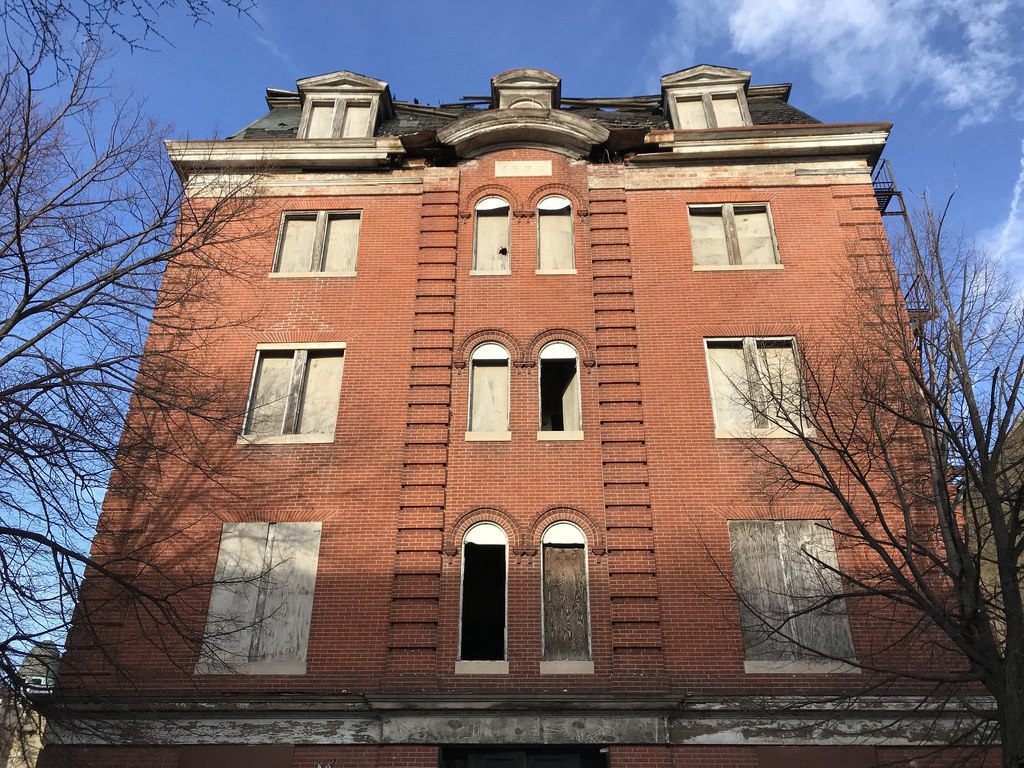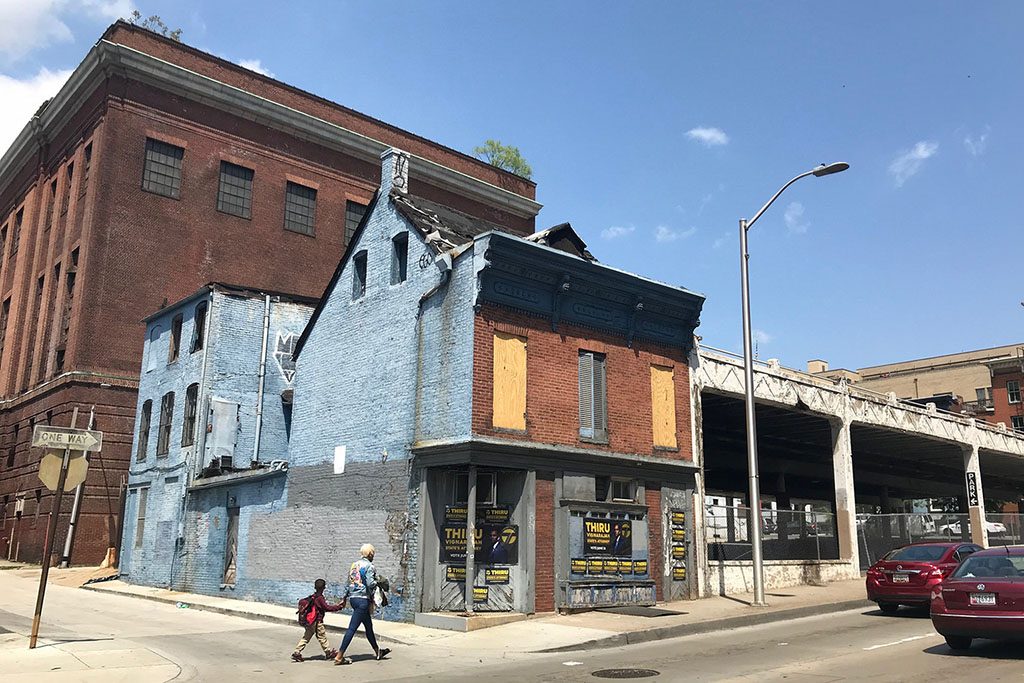
Martick’s Restaurant Francais on Mulberry Street is a place of fond memories where Baltimore enjoyed fine food, lively music, and art for nearly a century. After a decade of vacancy, the former restaurant is now threatened by a new development project.
While the developer, the Vituvius Development Company, has proposed reusing some buildings on the block, they are seeking to tear down Martick’s citing the difficulty of reusing the deteriorated structure. Yesterday afternoon, Baltimore’s Commission for Historical and Architectural Preservation (CHAP) voted unanimously to recognize the buildings importance to the local historic district—but the building may still be at risk.
The once-famous restaurant started in 1917 as a small grocery store established by Harry and Florence Martick, both Jewish Polish immigrants. The Federal style corner building is even older—dating back to at least 1852—and the Martick family continued to live above the shop raising a family of five children. Following the end of Prohibition, the store (which may have already been operating as an illegal speakeasy) turned into a bar later known as Martick’s Tyson Street Tavern. After Harry’s death in the the 1940s, Florence’s five children pitched in to keep the business going. Morris Martick turned the family bar into a unique institution reportedly attracting what journalist Alan Feiler called “a mix of artists, musicians, journalists, working Joes and assorted self-styled bohemians, beats and hipsters” in the 1940s and 1950s.
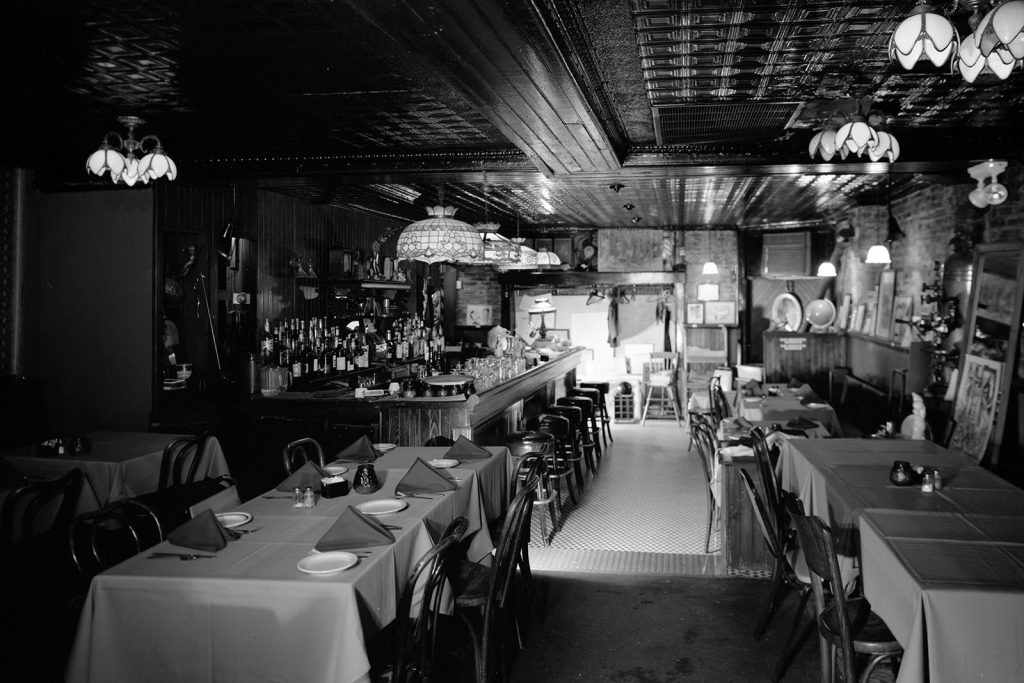
But, by the 1960s, Morris Martrick was ready for a change. After a failed run for state legislature, Morris traveled to France where he studied French cooking and attracted a chef. Returning to Baltimore, he renovated and re-opened the bar as Martick’s Restaurant Francais in 1970. The restaurant’s reputation grew, eventually attracting celebrity guests that include Baltimore-born filmmaker John Waters, actor Nicolas Cage and actress Barbara Hershey. The restaurant closed in 2008 and Morris Martrick passed away in 2011 at eighty-eight years old.
Regrettably, the building has sat vacant ever since the restaurant closed. After a proposal for redeveloping the building fell through last year, the property sold to Vituvius Development Company that has submitted a plan for the development of the entire block for a six-story apartment building with storefronts on the first floor and about one hundred apartments on the upper stories. While the proposal preserves and incorporates the historic buildings along Park Avenue, as well as a BG&E substation on the site, the developer is seeking the demolition of Martick’s as part of their plan. The adjoining parking lot was already torn down late last year in anticipation of the project.
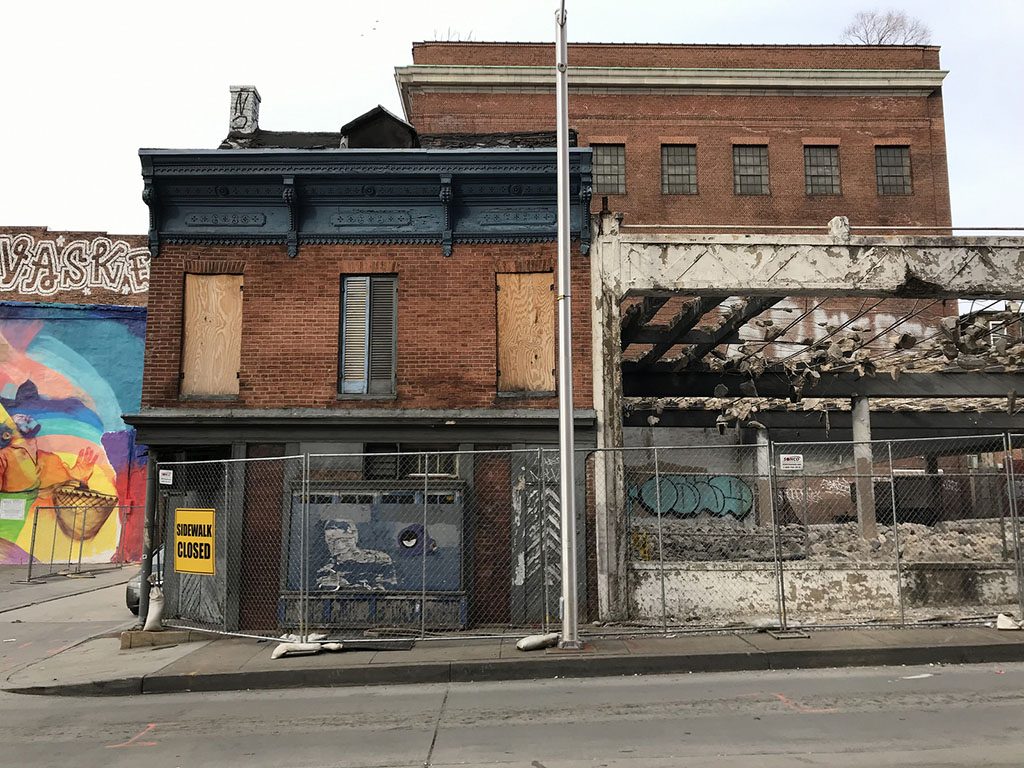
CHAP’s vote yesterday afternoon is the first step of a two-step process for property owners seeking to tear down buildings inside local historic districts. The developer could reconsider their plan and find a way to incorporate Martick’s into their proposal—or return to CHAP in the next few months to ask the commission to allow demolition under a “financial hardship” provision. As Ed Gunts reported in the Baltimore Fishbowl, the developer has cited concerns about the feasibility of redevelopment due to the “immense deterioration of the structure” over the past decade.
Baltimore Heritage is urging the developer to recognize Martick’s Restaurant Francais as a unique local landmark and reconsider their plans for demolition. We welcome new investment in long vacant buildings around Market Center but we also believe redevelopment can benefit from reusing historic buildings wherever possible.
You can join us in supporting the preservation of the former Martick’s Restaurant by emailing Stacy Montgomery, CHAP planner, at stacy.montgomery@baltimorecity.gov to share your support for the building’s preservation.