About Eli

Eli Pousson started as a Field Officer at Baltimore Heritage in partnership with the National Trust for Historic Preservation in October 2009. Prior to moving to Baltimore, Eli worked for the DC Office of Historic Preservation and completed graduate work in anthropology and historic preservation at the University of Maryland College Park. Eli continues to work with the Lakeland Community Heritage Project and other heritage organizations in Prince George’s County, Maryland.

West Baltimore Squares – Remembering the Celestial Ceiling of the Harlem Theatre

Thanks to Baltimore Heritage intern Elise Hoffman for researching and writing this post on the history of the Harlem Theatre. This post is cross-posted from the Friends of West Baltimore Squares blog.

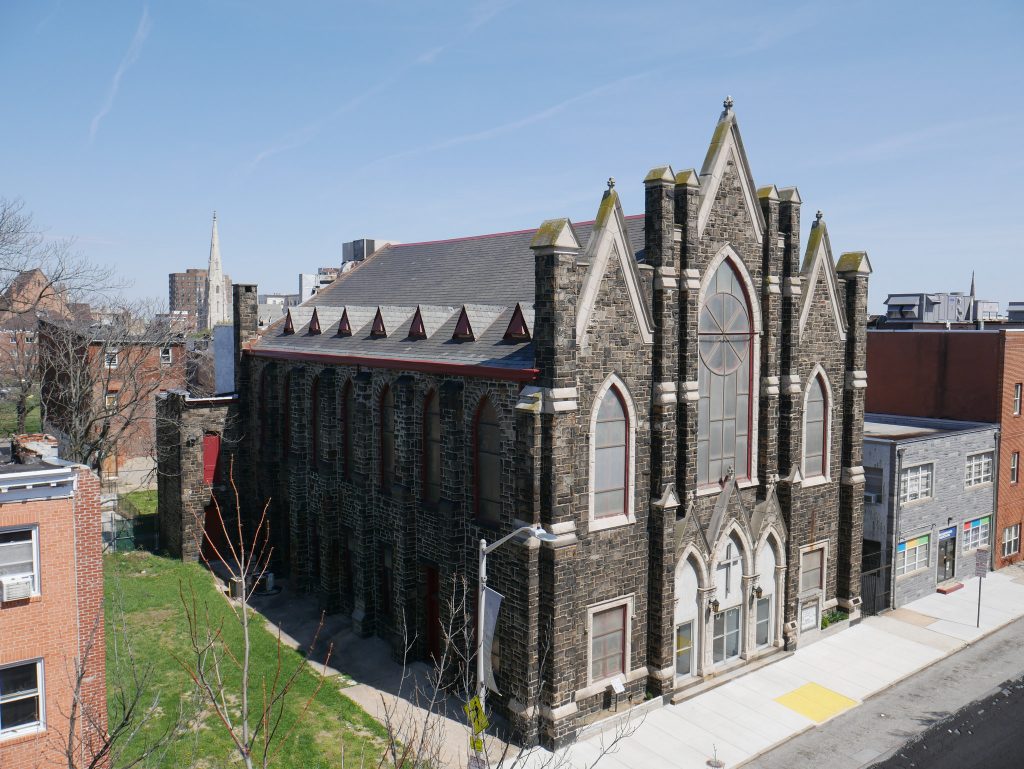
The Harlem Theatre, now known as the Harlem Park Community Baptist Church, is a local landmark on the western edge of Harlem Park– one of the city’s most extravagant African American movie theaters with a unique “celestial ceiling” featuring “twinkling electrical stars and projected clouds.” Built in 1902 as the home for the Harlem Park Methodist Episcopal Church, after they out grew their previous building, the structure still retains its ornamental Romanesque style with arched doors and windows made of rough blocks of Port Deposit granite.

Image courtesy the Maryland Historical Society, B1617

Harlem Park Methodist Episcopal Church did not remain in the area long however. After the building opened in 1903, two destructive fires — in December of 1908 followed by an even more severe fire in 1924 — led the congregation to sell the building and move out to a new church at Harlem and Warwick Avenues at the western edge of the developing city. At the same time the neighborhood began to transition from a largely segregated white to a predominantly black community, a change that almost certainly influenced the white congregation. In 1928, the congregation sold the church to Emanuel M. Davidove and Harry H. Goldberg, owners of the new Fidelity Amusement Corporation, established to build “a 1,500 seat motion picture theatre for Negroes…to be known as Harlem Theatre.”

The company hired architect Theodore Wells Pietsch, a notable Baltimore architect who also designed Eastern High School and the Broadway Pier. Pietsch took the property’s history into consideration when designing the new building: the theatre was made fireproof through the use of steel and concrete, and a fire extinguishing system was also included in the building’s design. Pietsh’s new design had an elaborate Spanish Mission theme described at the time as one of most elaborate designs on the East Coast and promoted as “the best illuminated building in Baltimore.” The bright façade included a 65-foot marquee with 900 50-watt light bulbs illuminating sidewalk underneath, “tremendous electric signs” around the marquee, and a forty-foot tall sign that could be seen from two miles away.

In October 1932, the owners organized a celebration to open the theater “in a blaze of glory” drawing jubilant crowds of 5,000 to 8,000 people. The jubilant scene was described by a journalist:

“The blazing marquee studded with a thousand lights made the entire square take a semblance of Broadway glamour. The marquees illuminated the entire Harlem Square which was crowded with those who lined the sidewalk unable to gain admittance.”

Over the next forty years, countless numbers of Baltimore residents enjoyed the theatre’s “cavernous three-story high ceiling, a balcony, carpeted floors and thick cushioned seats” and “celestial ceiling with twinkling electrical stars and projected clouds that floated over movie-goers’ heads.” The Harlem Theatre also hosted events supporting the broader community, such as a free “Movie Jamboree” in 1968 for the children of Baltimore workers donated by the theatre’s then-manager Edward Grot, and midnight shows to raise money for the local YMCA. Unfortunately for the Harlem, as movie theatres that previously discriminated against black customers began to desegregate in the mid 20th century, their business declined. By the mid-1970s, the Harlem Theatre had closed.

The building took on a new life in 1975 when Reverend Raymond Kelley, Jr. purchased the old theater and turned it into the Harlem Park Community Baptist Church dedicated on July 6, 1975. The building has been refurbished– the congregation traded in the old theater seats for pews and removed the large marquee–but much of the original historic character remains intact. Of course, the story of the Harlem Theatre also remains in the  memories of thousands of Baltimore residents and we hope you can share your stories with us in the comments.

Do you want to share your photos or stories of West Baltimore landmarks? Please get in touch with Eli Pousson at pousson@baltimoreheritage.org or 301-204-337.

Continue reading

Envisioning a new use for the Hebrew Orphan Asylum

The Coppin Heights Community Development Corporation recently completed a new Hebrew Orphan Asylum Adaptive Reuse Study with support from Baltimore Heritage, Preservation Maryland, and the National Trust for Historic Preservation. This report (available for download here) evaluates the restoration of this rare 19th century purpose-built orphanage and explores opportunities to return the building to use as a center for health care and healthy living. This study is a step forward in our ongoing effort to preserve the Hebrew Orphan Asylum.

In partnership with Coppin State University, the Coppin Heights CDC’s plan calls for creating a healthy foods market and a community health center in the building. Not only would this use provide an essential service to a West Baltimore community with limited access to fresh food and healthcare, it would also continue a rich tradition of social service at the Hebrew Orphan Asylum that began nearly 140 years ago.

Despite this good news, serious concerns remain as the distressed condition of the building–highlighted by the collapse this past February–urgently demands the immediate development of a financing plan to support the building’s stabilization and rehabilitation. Financing for projects similar to the Asylum often comes from a wide range of sources: tax credits, private commercial loans, and private donors just to name a few. To support this effort, Baltimore Heritage and the Coppin Heights CDC worked together to submit an application to the the state and federal historic rehabilitation tax credit programs. If the application is successful, the state and federal tax credits could provide up to an estimated $4,000,000 for rehabilitation– a tremendous investment in the future of the Hebrew Orphan Asylum and the neighborhoods of Greater Rosemont.

Please connect with the Friends of the Hebrew Orphan Asylum on Facebook to show your support for this landmark while following future developments for this great landmark.

Join an open conversation connecting people, places and the past at Bmore Historic

We’re excited to announce a new event for local historians, museum professionals, preservationists, archivists, activists, scholars, students and anyone who cares about engaging communities around our shared heritage. Join us on December 2, 2011 at the Maryland Historical Society for Bmore Historic– an unconference on public history, historic preservation and community development in Baltimore and across the state of Maryland.

What is an “unconference”?

Anyone who goes to conferences knows that the most productive conversations often take place in the hallway or over drinks at the end of the day. An unconference takes this idea and runs with it. Unlike most traditional academic or professional meetings, an unconference is created and managed by the participants, with the topics of discussion sessions or workshops determined by everyone who attends on the day of the meeting, rather than in advance by the organizers. New unconferences are being organized around the country with examples including PubCamp for professionals in public media, Book Camp on books & publishing, THATCamp for scholars working with digital humanities, and (locally) CreateBaltimore unconference for art & technology. You don’t need to worry about preparing a PowerPoint or a formal paper, we’re just looking for people who are excited about historic places and ready share their knowledge and collaborate with

Why should I participate?

Bmore Historic is an opportunity to share your work, learn from others, get new ideas and develop new partnerships. This meeting is not limited just to scholars or professionals. Students, volunteer preservation activists, Main Street board members, museum docents, educators and others are all encouraged to register and attend. We hope that Bmore Historic can help strengthen connections between people who work with public history, preservation and community development across the region while expanding the diversity of the broader heritage community.

How do I register?

Online registration for the meeting is now open on our website. We’re accepting registrations on a first come, first served basis with confirmations starting in early November. After we confirm your registration, you’ll have a chance to share your session ideas in a blog post on the Bmore Historic website and check out ideas from other participants.

What does it cost?

We’re committed to charging $20 or less. With the space generously donated by the Maryland Historical Society, our costs are limited and we’re currently seeking funds to reduce the charge for all participants. This charge will be finalized by early November. If you are interested in sponsoring Bmore Historic, please get in touch with Eli Pousson at pousson@baltimoreheritage.org.

We’ll kick off the meeting on the evening of December 1 with “Giving the Past Presence: Public History Experiments in New York City” — a UMBC Humanities Forum with Marci Reaven, former director of City Lore and co-founder of Place Matters. We hope this talk can provide an inspiration for the conversations the next day. On December 2, we’ll be at the Maryland Historical Society with sessions in the morning and afternoon. Breakfast and lunch are both provided.

Bmore Historic is being organized in partnership with the Greater Baltimore History Alliance, the Maryland Association of History Museums, the Maryland Historical Society, the Maryland Historical Trust, Preservation Maryland, and the UMBC Orser Center for the Study of Place, Community, and Culture. If you have any questions, please get in touch with Eli Pousson at pousson@baltimoreheritage.org or 301-204-3337. We hope to see you in December!

Civil War 150: West Baltimore’s Civil War History by Bike — Rescheduled

Many people know that President Street Station has its roots in the Civil War, but few know that Civil War history can be found throughout the city, including many sites in West Baltimore. In fact, West Baltimore neighborhoods served a central role in the conflict– housing Union troops on their south to fight, caring for injured soldiers, and witnessing the many ways in which the conflict on the battlefield came home to the city 150 years ago. As the home to the B&O Railroad, West Baltimore supported the movement of troops by train (a key advantage for the Union) and protected the city from invasion by Confederate troops through a ring of camps, hospitals and fortifications in Carroll Park, on Baltimore Street, in Lafayette Square and more.

West Baltimore’s Civil War History by Bike

Update: Due to today’s rainy and snowy weather, we have rescheduled our tour to Saturday, November 5, 10:00 am. Please contact Eli Pousson at pousson@baltimoreheritage.org or 301-204-3337 with any questions or concerns.

October 29, 2011, 10:00 am to 11:30 am
$10 for members & non-members, RSVP today!

This 90-minute bicycle tour starts and ends at the Mt. Clare Museum House rolling past rowhouses, parks, stables, and shops, scores of historic places grand and modest, where people lived and worked during the Civil War and its aftermath. We’ll learn about Confederate spies at Waverly Terrace in Franklin Square, take a look at the historic artifacts we recently dug up from the site of Lafayette Barracks, and trace the lives of immigrant workers who built the trains, bridges, and more that the Union military depended on at the Irish Shrine at Lemmon Street and the B&O Railroad Roundhouse. Please join us as we pedal through the history of the Civil War in West Baltimore and commemorate this nation-shaping event of 150 years ago.

Thanks to the support of Free Fall Baltimore at the end of the tour participants are welcome to take a free tour of the Mt. Clare Museum House. Mount Clare is a 1760 colonial Georgian home built by Charles Carroll and Maryland’s oldest house museum.

Connect with the Friends of West Baltimore Squares to learn more about heritage and community greening programs in West Baltimore neighborhoods!

Young Preservationist Happy Hour in Fell’s Point on September 29

Baltimore’s Young Preservationist Happy Hour is headed down to southeast Baltimore (finally!) on Thursday, September 29. Fell’s Point has been a vibrant historic neighborhood for nearly 300 years and we’re sure that it has had its share of great bars since the early 1700s. Located in a building dating from 1858, One-Eyed Mike’s on Bond Street still has an 1860s hand-carved back bar and the original tin ceiling. Their Thursday happy hour includes specials on draft beer, call cocktails and wine by the glass through 7:00 pm. We’ll be enjoying the start of fall out on the back patio, which Baltimore City Paper declared the place for Baltimore’s Best Outdoor Dining.

Young Preservationist Happy Hour in Fell’s Point

One-Eyed Mike’s, 708 South Bond Street
Thursday, September 29, 6:00pm – 8:00pm
RSVP today!

This month’s Happy Hour is co-hosted by the Preservation Society– the historic preservation nonprofit for Fell’s Point and Federal Hill. Among other things, the Preservation Society is at the heart of why Fell’s Point is a great neighborhood and not an interstate highway, so be sure to check the box to learn more about their work and upcoming programs. If this is your first Baltimore Heritage event, we’ll give you a free membership with discounts on tours and a subscription to our quarterly newsletter. Please RSVP for a chance to win pair of Behind the Scenes Tour tickets.

Baltimore’s Young Preservationist Happy Hour meets Wikipedia

Baltimore’s Young Preservationist Happy Hour is back in Mount Vernon on Friday, July 22 for our usual beers plus a quick talk from the the new Wikipedian-In-Residence at the Smithsonian Archives of American Art! Can’t get enough Wikipedia in one evening? Come out to the first GLAM Wiki Partnerships in Baltimore meeting hosted by the Walters Art Museum on Saturday, July 23.

Young Preservationist Happy Hour meets Wikipedia

Friday, July 22, 6:30 pm to 8:30 pm
Midtown Yacht Club, 15 East Centre Street, Baltimore, MD 21202
RSVP Today!

Despite the name and its location just across the street from the historic Peabody Conservatory, the Midtown Yacht Club is an unpretentious neighborhood bar with affordable drinks (all beer & cocktails will be 50 cents off all evening) and a solid Tex-Mex influenced bar menu. Come early to grab your beer and get settled so you can enjoy our talk on exciting new partnerships between Wikipedia and cultural heritage organizations at 6:30 pm.

From the British Library to the Children’s Museum of Indianapolis, cultural heritage organizations are partnering with the Wikipedian community to share collections of historic photographs, document public art, celebrate local landmarks, and more. Join us for a short talk by Sarah Stierch–the new Wikipedian-in-Residence for the Smithsonian Archives of American Art–starting at 6:30 pm or just drop by for a beer when you can.

GLAM Wiki Partnerships in Baltimore

Saturday, July 23, 10:00 am to 12:30 pm
Walters Museum, 600 North Charles Street
RSVP by July 18

If you work with a cultural heritage organization and you’re interested in developing your own partnerships with Wikipedians and the Wikimedia community, join us for the first GLAM Wiki Partnerships in Baltimore meeting hosted by the Walters Museum. We’ll start with an introduction to how GLAMs (Galleries, Libraries, Archives, and Museums) across the country are partnering with Wikipedia from Wiki DC organizer Katie Flibert and museum professional Sarah Stierch. This introduction will be followed by a presentation by Dylan Kinnett on new online engagement efforts by the Walters Art Museum. We’ll then conclude with a lively brainstorming session on new opportunities here in Baltimore. Please RSVP for this meeting by July 18!

Civil War Archeology in Lafayette Square

The markings of Baltimore’s Civil War heritage are all around us, from downtown landmarks like President Street Station, to military buttons, ceramic ware, and bits of metal of every variety that lie literally under our feet. To help commemorate the 150th anniversary of the beginning of the Civil War this year, please join Baltimore Heritage and the Friends of West Baltimore Squares on July 9 as we dig into the history of Civil War-era Baltimore with an archeological investigation in Lafayette Square. We’re not sure what we’ll find under the topsoil, but we do know that the Square was the site of Lafayette Barracks during the civil war, a military camp and hospital that housed 1000 people strong. With support from the Archaeological Society of Maryland, the Maryland Historical Trust, and the local community, we are conducting an archaeological investigation of Lafayette Barracks, the military camp and hospital located in the park during the Civil War. Please stop by to talk to the archeologists, learn about urban archeology, and West Baltimore’s Civil War history. Throughout the afternoon, we will be offering walking tours, exhibits on the architectural history of the Square, and even grilled hotdogs!

Civil War Archeology in Lafayette Square

Saturday, July 9, 2011
Lafayette Square Park (West Lafayette Avenue & North Arlington Street)
11:00 AM to 3:00 PM
Tours, talks, and exhibits throughout the day and hotdogs at noon. On-street parking available. to look up directions, use 1100 W. Lafayette Avenue, Baltimore 21217.
RSVP Today!

From 1861 through 1865, as the United States were split by civil war, Lafayette Square in West Baltimore became a bustling military encampment and a rich scene of Baltimore’s Civil War life. Originally known as Camp Hoffman–named for Henry W. Hoffman, collector for the Port of Baltimore–the camp housed at least five Maryland Union regiments as well as troops from New York and other northern states. The Camp, including a hospital, sutler’s store, kitchen and parade grounds, served as a rendezvous point for Maryland and Delaware Union troops with as many as to 1,000 soldiers preparing for active duty at a time. In the blocks around the camp, one could find military bands marching down to Jarvis Hospital on Baltimore Street, drunken brawls at local bars between soldiers and civilians, deserters escaping through Druid Hill Park shot down by cavalrymen, and escaped slaves from the Eastern Shore taking refuge with Union troops before seeking freedom to the north. John Scharf, Baltimore’s foremost historian during the late 19th century, described Lafayette Square in 1865 as “filled with ugly wooden sheds, swarming with rough troops, while not one of the elegant mansions now surrounding it had been reared.”

Our archaeological investigation, led by archeologists Brandon Bies, MAA and Dr. David Gadsby, seeks to learn more about people who lived and worked at Lafayette Barracks during the Civil War by searching for any artifacts or surviving physical evidence that they left behind. With a dozen trained volunteers, our team will use metal detectors to search out metal artifacts, such as buttons or bullets, and open up a small area of excavation to search for the remains of Camp Hoffman. Stop by on July 9 to learn more about West Baltimore’s Civil War history and the process of historical archeology. We’ll be leading short walking tours every hour, sharing exhibits on the history and community of Lafayette Square, and hosting the Baltimore Civil War Museum with exhibits on archeology at President Street Station. Please RSVP if you’re planning to join us! Questions? Contact Eli Pousson at pousson@baltimoreheritage.org or 301-204-3337.

West Baltimore Walks at the 2011 ROOTS Festival

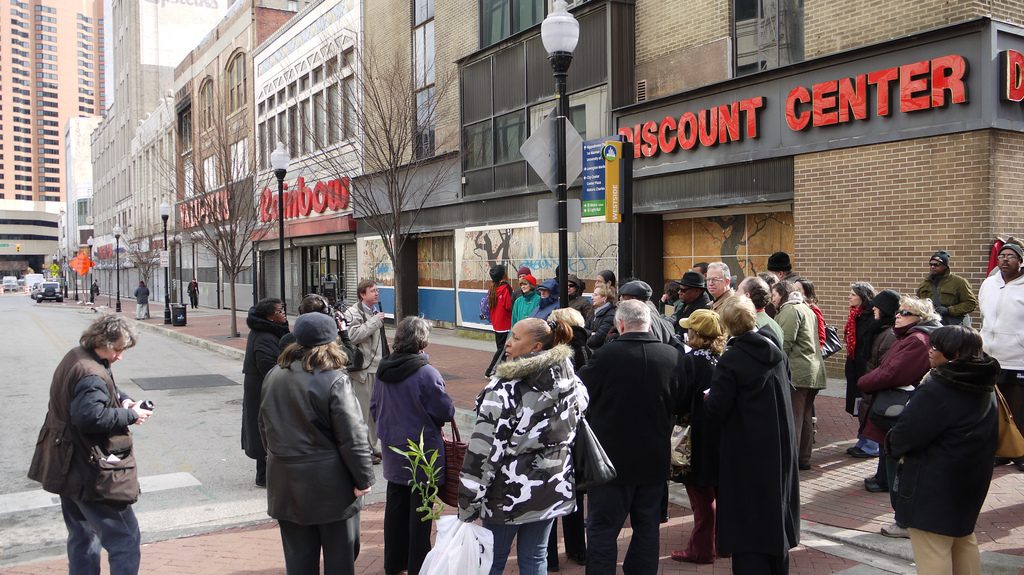
This weekend the 2011 ROOTS Festival comes to the Highway to Nowhere in West Baltimore, and we are leading neighborhood walking tours as part of it. Please join us if you can. The festival is a series of music, arts and community events, some outdoor and some indoor, starting at Franklin and North Gilmor Streets (just west of Martin Luther King Boulevard). As part of our continuing work with the Friends of West Baltimore Squares partnership, we’ll be at the festival both Saturday & Sunday, June 25-26, sharing information on upcoming programs and offering a series of West Baltimore Walks through the historic parks and innovative new gardens to the north and south of the Highway to Nowhere.

Baltimore Heritage at the Alternate ROOTS Festival

Saturday & Sunday, June 25-26
West Baltimore Walks at 11:00 am, 1:00 pm, & 3:00 pm
FREE!
RSVP today!

Meet at the corner of Franklin and Carey Streets at the festival.

The one-hour walking tours, led by Baltimore Heritage’s Eli Pousson, start from the “Community Bridge” at the corner of Franklin & Carey Streets. They will go through Harlem Park & Lafayette Square exploring schoolyard gardens and soaring historic churches, and through Franklin Square & Union Square stopping by the H.L. Mencken House and innovative vacant lot projects on Brice and Carey Streets.

Continue reading

Vote for the McKim Free School in the This Place Matters Community Challenge


Baltimore’s McKim Free School is a rare treasure– a 1833 landmark with deep roots in the city’s history and an unsurpassed 175 year record of education and social service. Since 1945, this building has been home to the McKim Center as it has grown as a vital institution serving children and adults in need in the Jonestown community in innumerable ways. However, the building, owned by the City of Baltimore and managed by the non-profit McKim Center, has some significant challenges with a leaky roof and cracked masonry demanding a significant restoration. The importance of this architecturally significant building as a living symbol of caring, generous assistance is clearly expressed by McKim’s executive director Dwight Warren–who has been personally involved with the McKim Center for nearly 50 years–

Much of that symbolic strength is derived from the massive stone walls, columns, lintels, pediment, and other features that are now at risk, caused by age, wear, and the elements. Cracking, spilling, water damage, and general deterioration threaten to accelerate these processes if not checked by repair and replacement.

You can help to restore this unique Baltimore building and support an essential neighborhood institution by voting right now for the McKim Free School in the This Place Matters Community Challenge organized by the National Trust for Historic Preservation. With your support, we have a chance to win up to $25,000 for the continued restoration of the McKim Free School building. Online voting for the McKim School, one of 100 great historic places across the country, continues through June 31. You can only vote once so we need your help to share this opportunity with your friends and neighbors and encourage them to join your cause.

How do I vote to support the McKim Free School?

  1. Register with the National Trust for Historic Preservation online then check your email for your new username and password. If you voted for the Hebrew Orphan Asylum last fall or if you are a member of the National Trust for Historic Preservation you can use the same form to receive a reminder with your username and password.
  2. Login and vote in the This Place Matters Community Challenge for the McKim Free School  to help us win $25,000.
  3. Don’t forget to connect with Baltimore Heritage and the McKim Free School on Facebook for updates on upcoming events and our continued restoration effort. Please spread the word about this great opportunity with your family, friends and neighbors!

Questions? Contact Eli Pousson at  pousson@baltimoreheritage.org.

Baltimore’s Young Preservationist Happy Hour in the Station North Arts District

Start your Memorial Day weekend with a happy crowd of architects, archivists, planners and folks who just love old buildings and join us us for our third Young Preservationist Happy Hour at Joe Squared on North Avenue.

Young Preservationist Happy Hour | 133 W. North Avenue

Friday, May 27, 2010
6:00 pm to 8:00 pm
RSVP Today!

Since 2005, Joe Squared has anchored the corner of Howard Street and West North Avenue in an early 20th century block first used as a tavern back in the 1950s. No specials on tap this time but with outdoor seating and a menu of unique pizzas, salads, and sandwiches, Joe’s is a can’t miss destination on North Avenue. If this is your first Baltimore Heritage event, we’ll give you a free membership with discounts on tours and a subscription to our quarterly newsletter. Please RSVP for a chance to win discounted tickets to the 2011 Baltimore Heritage Awards Celebration in historic Union Square Park.

Take a tour of the Station North Arts District with the Central Baltimore Partnership


Joe Squared isn’t the only exciting new business and neat historic building on North Avenue. Join Ashley Wallace, Community Planner for the Central Baltimore Partnership, on a quick 30 minute walking tour starting at the Charles Theater at 5:25 PM. We’ll stop by the Crown Cork & Seal Co. Building (better known at the Copycat) where William Painter invented the bottle cap in 1891 along with new arts spaces like the Load of Fun Gallery. When you RSVP just let us know if you’re coming early for the tour.